![]() |
|||||||||||||||||||||||||||||||||||||||||||||||||||||||||||||||||||||||||||||||||||||||||||||||||||||||||||||||||||||||||||||||||||||||||||||||||||||||||||||||||||||||||||||||||||||||||||||||||||||||||||||||||||||||||||||||||||||||||||||||||||||||||||||||||||||||||||||||||||||||||||||||||||||||||||||||||||||||||||||||||||||||||||||||||||||||||||||||||||||||||||||||||||||||||||||||||||||||||||||||||||||||||||||||||||||||||||||||||||||||||||||||||||||||||||||||||||||||||||||||||||||||||||||||||||||||||||||||||||||||||||||||||||||||||||||||||||||||||||||||||||||||||||||||||||||||||||||||||||||||||||||||||||||||||||||||||||||||||||||||||||||||||||||||||||||||||||||||||||||||||||||||||||||||||||||||||||||||||||||||||||||||||||||||||||||||||||||||||||||||||||||||||||||||||||||||||||||||||||||||||||||||||||||||||||||||||||||||||||||||||||||||||||||||||||||||||||||||||||||||||||||||||||||
Inventory of Depressive Symptomatology (IDS) & Quick Inventory of Depressive Symptomatology (QIDS)ABOUT THE IDS AND QIDS
VALIDITY
RELIABILITY
GENERALIZABILITY
ADMINISTRATIONSCORINGINTERPRETATION
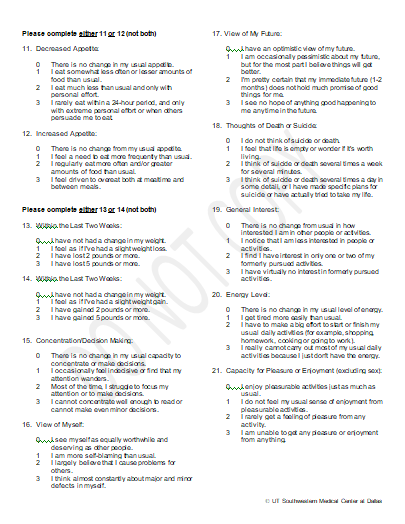
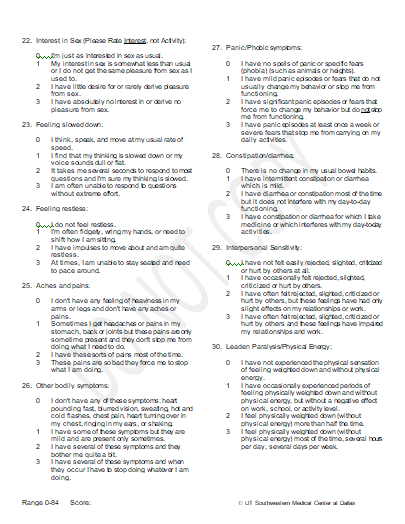
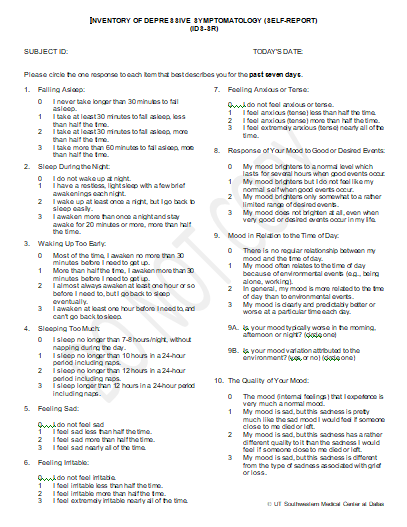
SCALES AND TRANSLATIONS AVAILABLELIMITATIONSMORE INFORMATIONREFERENCESABOUT THE IDS AND QIDS ^The 30 item Inventory of Depressive Symptomatology (IDS) (Rush et al. 1986, 1996) and the 16 item Quick Inventory of Depressive Symptomatology (QIDS) (Rush et al. 2003) are designed to assess the severity of depressive symptoms. Both the IDS and the QIDS are available in the clinician (IDS-C30 and QIDS-C16) and self-rated versions (IDS-SR30 and QIDS-SR16). The IDS and QIDS assess all the criterion symptom domains designated by the American Psychiatry Association Diagnostic and Statistical Manual of Mental Disorders - 4th edition (DSM-IV) (APA 1994) to diagnose a major depressive episode. These assessments can be used to screen for depression, although they have been used predominantly as measures of symptom severity. The seven day period prior to assessment is the usual time frame for assessing symptom severity. The QIDS-C30 and QIDS-SR16 cover only the nine diagnostic symptom domains used to characterize a major depressive episode, without items to assess atypical, melancholic or their commonly associated symptoms. All 16 items on the QIDS are included within the IDS. The IDS-C30 and IDS-SR16 include the criterion symptoms, as well as commonly associated symptoms (e.g. anxiety, irritability) and items relevant to melancholic, or atypical symptom features. Both the IDS and QIDS are easy to administer in either the clinician-rated (IDS-C30 and QIDS-C16) or patient self report (IDS-SR30 and QIDS-SR16) versions; they require minimal training. Both versions are sensitive to change, with medications, psychotherapy, or somatic treatments, making them useful for both research and clinical purposes. The psychometric properties of both the IDS and QIDS, have both been established in various study samples. Background and RationaleThere are several accepted clinician rated and patient self report measures of depressive symptoms. The most commonly used clinician rated scales are the 17, 21, 24, 28, and 31 item versions of the Hamilton Rating Scale for Depression (HRSD) (Hamilton 1960, 1967), and the 10-item Montgomery-Asberg Scale (Montgomery and Asberg 1979). The most frequently used self-reports include the 13, and 21 item version of the Beck Depression Inventory (BDI) (Beck et al. 1961), the BDI-II (Beck et al. 1996), the Zung Depression Rating Scale (Zung 1965), the Carroll Rating Scale (CRS) (Carroll et al. 1981), and the Patient Health Questionnaire - 9 (PHQ-9) (Kroenke et al. 2001). The IDS and QIDS have been compared to several of these measures. The IDS and QIDS were developed to improve on the available clinician and patient ratings by 1) providing equivalent weightings (0-3) for each symptom item; 2) providing clearly stated anchors that estimate the frequency and severity of symptoms; 3) including all DSM-IV criterion items required to diagnose a major depressive episode; and 4) providing matched clinician and patient ratings (Rush et al. 1986, 1996, 2003, 2005, in press, Gullion and Rush 1998, Trivedi et al 2004). The items on the self report and clinician rated versions of the IDS-C30 and IDS-SR30 rate identical symptoms with equivalent anchors, as do the items of the QIDS-C16 and QIDS-SR16. The self-report versions, the IDS-SR30 and QIDS-SR16 were developed to be easy to use severity measures, providing a potentially more time efficient alternative to the IDS-C30 and QIDS-C16 in both clinical or research settings. Evidence of acceptable psychometric properties of the IDS-C30 and IDS-SR30 in depressed outpatients (Rush et al. 1996, 2000, 2003, in press, Gullion and Rush 1998, Trivedi et al. 2004) and depressed inpatients (Corruble et al. 1999) is available. There is also a substantial correlation between total scores on the IDS-C30, IDS-SR30, and the HRSD17 (Rush et al 1986, 1996, Gullion and Rush 1998). The IDS ratings have been shown to differentiate endogenous from nonendogenous depressions (Rush et al. 1987, Domken et al. 1994), dysthymic disorder from major depressive disorder (Rush et al. 1987), depressed from nondepressed radiation oncology patients (Jenkins et al. 1998), and depressed from nondepressed cocaine-dependent jail inmates (Suris et al. 2001). Following the development of the IDS-C30 and IDS-SR30, at the suggestion of Per Bech M.D., we decided to provide a shorter, time-efficient, 16-item version for use in clinical research and daily practice, that focuses only on the nine DSM-IV criterion symptom domains. The resulting scales are called the Quick Inventory of Depressive Symptomatology Clinician Rating (QIDS-C16) and the Quick Inventory of Depressive Symptomatology Self Report (QIDS-SR16). The QIDS ratings were constructed by selecting only items from the 30 item scales needed to assess the nine DSM-IV criterion diagnostic symptom domains. The scoring system of the QIDS converts responses to the 16 separate items into the nine DSM-IV symptom criterion domains. The nine domains comprise 1) sad mood; 2) concentration; 3) self criticism; 4) suicidal ideation; 5) interest; 6) energy/fatigue; 7) sleep disturbance (initial, middle, and late insomnia or hypersomnia); 8) decrease or increase in appetite or weight; and 9) psychomotor agitation or retardation. The total score ranges from 0 to 27. Note that the IDS30 contains all of the QIDS16 items, as well as mood reactivity, distinct mood quality, diurnal mood variation, irritable mood, anxious mood, capacity for pleasure, sexual interest, bodily aches and pains, panic or phobic symptoms, digestive problems, interpersonal rejection sensitivity, and leaden paralysis (Rush et al 1996). Both the IDS30 and QIDS16 rate symptoms for the prior 7 days (independent of whether they have been chronic, long-standing, or recent). VALIDITY ^ContentThe IDS-SR30, IDS-C30, QIDS-SR16, and QIDS-C16 include items that rate the nine item symptom domains used to define a major depressive episode (APA 1994) (ICD-10). The IDS-SR30 and IDS-C30 include additional items to define melancholic and atypical symptom features, as well as their commonly associated symptoms (e.g. irritability, anxiety), and endogenous symptom features defined by the Research Diagnostic Criteria (RDC) (Spitzer et al. 1978). CriterionTo determine if the IDS-SR30 and IDS-C30 measure depression in a manner consistent with the most widely used assessments, Rush et al. (1996) examined the relationship between IDS and QIDS scores, and HRSD17 and BDI scores in a sample of 434 outpatients with major depressive disorder (MDD) and 103 normal controls. IDS and QIDS total scores were comparable to those obtained by the HRSD17 and BDI, with Pearson product moment correlations of 0.95 between the IDS-C30 and the HRSD17, and 0.88 between the IDS-SR30 and the HRSD17. The correlation coefficient between the IDS-C30 and IDS-SR30 was 0.91. The correlation between the BDI21 and the IDS-C30 was 0.86, while it was 0.93 between the BDI21 and the IDS-SR30. The correlation between the BDI21 and the HRSD17 was 0.85. In a sample of 68 newly admitted inpatients with MDD Corruble et al. (1999) found the MADRS to be correlated with the IDS-C30 (c=0.81); and the 20 item depression factor from the SCL-90 (Derogatis 1977) were correlated with the IDS-SR30 (c=0.84). Rush et al. (2004) found high correlations between the QIDS-SR16, and the IDS-SR30 (c=0.96), HRSD17 (c=0.81), HRSD21 (c=0.82), and HRSD24 (c=0.84) at the exit interview after 12 weeks of acute phase outpatient treatment (n=596). Additionally, correlations between the IDS-SR30 and the HRSD17, HRSD21, HRSD24 total scores were 0.84, 0.85, and 0.86, respectively. Providing evidence that the IDS and QIDS are measuring depressive symptoms in the same manner, Trivedi et al. (2004) found the QIDS-SR16 total score was highly correlated with the IDS-SR30 total score for 544 adult outpatients with MDD (c=0.83). They also found robust correlations between the QIDS-C16 and IDS-C30 total scores for out patients with MDD (c=0.82, n=544) and Bipolar Disorder (BD) (c=0.81, n=402). The IDS30 and QIDS16 are sensitive to changes in depressive severity in a manner consistent with the HRSD and BDI, with the IDS and QIDS demonstrating a greater sensitivity to change in the lower range of scores reported by 434 outpatients patients with MDD and 103 normal controls (Rush et al. 1996). In 68 newly admitted inpatients with a diagnosis of MDD, Corruble et al. (1999) found the IDS-C30 and IDS-SR30 to be as sensitive to change as the MADRS and the SCL-90 (depression subscale). In 62 patients with MDD, Biggs et al. (2000) found the IDS-C30 and IDS-SR30 to be significantly more sensitive to detecting change than standard five item visual analogue physician and patient self report global rating scales. In a retrospective analysis, Rush et al. (2000) found comparable levels of sensitivity to change in depressive severity when comparing HRSD24 and the IDS-SR30 scores in a sample of 993 outpatients with MDD. In 596 adult outpatients with chronic, nonpsychotic MDD Rush et al. (2003) found the IDS-SR30 and QIDS-SR16 were equally sensitive to symptom change, when viewed as a discontinuous variable (response or remission), although the QIDS-SR16 seemed to be slightly less sensitive to residual symptoms that the longer IDS-SR30. In 544 outpatients with MDD, and 402 outpatients with Bipolar Disorder (BP), Trivedi et al. (2004) reported finding equal sensitivity to symptom change when comparing the IDS-C30, IDS-SR30, QIDS-C16, QIDS-SR16, indicating high concurrent validity for all four scales. High concurrent validity was also documented based on the Medical Outcomes Study 12-item Short Form (SF-12) (Ware et al. 1996) mental health summary score for the population divided in quintiles based on their IDS and QIDS score. In 681 patients with chronic MDD assigned to 3 treatment groups (medication alone, medication and psychotherapy, psychotherapy alone), Rush et al. (2005) compared the HRSD24 and the IDS-SR30 and QIDS-SR16 ratings, finding comparable change scores within groups. In addition, the IDS-SR30 and QIDS-SR16 confirmed response and remission rates based on the HRSD24. ConstructThe IDS and QIDS have been used to distinguish response from remission (Rush et al. 1996, 2000, 2003, 2004, 2005, Biggs et al. 2000, Trivedi et al. 2004), as well as to quantify between group treatment effects in open label and randomized controlled trials (Rush et al. 1996, 2000, 2003, 2005, Biggs et al. 2000, Trivedi et al. 2001, 2004, Corruble et al. 1999). The IDS assessments have demonstrated sensitivity and specificity equal to or in excess of the HRSD (Rush et al. 1996, 2000, 2003, in press), BDI (Rush et al. 1996), MADRS and SCL-90 (Corruble et al. 1999), with the IDS assessments showing a slight advantage in the lower scoring ranges (Rush et al. 1996, Corruble et al. 1999). In 353 depressed outpatients, Rush et al. (1996) found three factors, 1) cognitive / mood, 2) anxiety / arousal, and 3) sleep and appetite regulation. However, the IDS is sufficiently unifactorial to allow for IRT analyses, and to create conversion tables with other standard ratings (Rush et al. 2003). Gullion and Rush (1998) factor analyzed a sample of 324 adult outpatients with MDD, concluding that when comparing the IDS with the HRSD, and the BDI, the IDS provided more complete coverage of the symptom constructs defined by the factor structure of the combined assessment items (Gullion and Rush 1998). RELIABILITY ^Internal ConsistencyRush et al. (1996) reported the psychometric properties of the IDS-C30 and IDS-SR30 using a sample of 456 subjects (338 adult outpatients with MDD, and 118 normal controls). Cronbach's alpha (Cronbach 1951), was 0.94 for both the IDS-C30 and IDS-SR30 for the complete sample (n=456), and 0.67 and 0.77 for the IDS-C30 and IDS-SR30, respectively, for the sample of MDD patients (n=338). The results are contrasted with 0.89 for the HRSD17 and 0.94 for the BDI21 for the complete sample, and 0.53 for the HRSD17 and 0.83 for the BDI21 for the sample of MDD patients. In a sample of 68 newly admitted adult inpatients with MDD, Corruble et al. (1999) found a Cronbach's alpha coefficient of 0.75 and 0.79 for the IDS-C30 and the IDS-SR30 respectively. The authors also reported a Cronbach's alpha of 0.80 for the MARDS, and 0.95 for SCL-90 depression subscale in the same sample. Biggs et al. (2000) reported a Cronbach's alpha of 0.82 for the IDS-C30 and 0.83 for the IDS-SR30 in a sample of 62 adult patients with MDD (28 inpatients, 34 outpatients). In a study of 596 adult outpatients with chronic, nonpyschotic MDD, Rush et al (2003) reported Cronbach's alpha for the IDS-SR30, QIDS-SR16, HRSD17, HRSD21, and HRSD24. This study revealed high internal consistency for all the scales; 0.92 for the IDS-SR30; 0.86 for the QIDS-SR16; 0.83 for the HRSD17; 0.84 for the HRSD21; and 0.88 for the HRSD24. Recently, Trivedi et al. (2004) reported the psychometric properties of the QIDS-C16 and QIDS-SR16, as well as those of the original IDS-C30 and IDS-SR30. The authors assessed 544 patients with MDD and 402 with Bipolar Disorder (BD) using the QIDS-C16, QIDS-SR16, IDS-C30 and IDS-SR30. Cronbach's alpha was 0.85 (QIDS-C16), 0.86 (QIDS-SR16), 0.90 (IDS-C30), 0.92 (IDS-SR30) for the MDD patients, and 0.81 (QIDS-C16), 0.89 (IDS-C30) for the patients with BD. GENERALIZABILITY ^Both versions of the IDS have been used in nonpsychotic and psychotic MDD (Rush et al. 1986, 1996, 2003, Trivedi et al. 2001, 2004), postpartum depression (Yonkers et al. 2001), dysthymic disorder (Rush et al. 1987, 2005), minor depression (Rappaport et al. 2002, Nina et al. 2002, Judd et al. 2004), bipolar disorder (Rush et al. 1986, Denicoff et al. 2000, Suppes et al. 2002, Trivedi et al. 2004), as well as in patients with depression comorbid with cancer (Jenkins et al. 1998) and asthma (Brown et al. 2001). The IDS and QIDS have been used in a variety of research and clinical settings, including inpatient and outpatient psychiatric clinics, and primary care settings. They are under investigation in elderly and adolescent patients. These assessments have been widely used in both clinical and research settings, and have begun to be utilized as outcomes in industry sponsored randomized controlled trials. For a partial list of published uses of the IDS and QIDS see Table 1. Additional ApplicationsThe QIDS and IDS have been converted to an Interactive Voice Response system (IVR) which has been used to collect data directly from study patients. IVR is a computerized assessment administration system that uses a standard phone line to obtain patient responses, using a touchtone phone or response to a prerecorded voice asking specific questions. The IVR versions of the IDS/QIDS are the property of Health Technology Systems Inc. (see below) and are not in the public domain. Additionally, the IDS and QIDS have been incorporated into symptom severity driven, computer supported algorithmic pharmacotherapy. ADMINISTRATION ^The patient is asked to rate the severity and frequency of specific symptoms present over the last 7 days. The clinician versions (IDS-C30 and QIDS-C16) are completed by a clinician or trained rater. It takes approximately 10 to 15 minutes to administer the IDS-C30, and 5 to 7 minutes to complete the QIDS-C16. The clinician proceeds through the items, asking the patient to report on each item of the IDS-C30, or QIDS-C16. The symptoms are familiar to clinicians, as the individual items are defined by the constructs represented in the DSM-IV criteria for MDD. Each item is interval scaled from 0 to 3; 0 indicates absence of the symptom during the last 7 days. The anchors are intended to help raters represent the frequency and intensity associated with each item / symptom. An adjunctive semi-structured interview guide is available in the English and Spanish versions of the IDS-C30 and QIDS-C16. They provide a set of standardized introductory questions and follow-up prompts that are helpful in standardizing test administration. The semi-structured interview format guides less clinically experienced test administrators in test administration, assuring the constructs underlying the items are queried in a consistent manner, thus allowing for a high degree of confidence in the interpretations and subsequent generalizability of the scores obtained. When administering the self-report version, patients should be instructed to take their time, read each item carefully, read all the possible responses, and choose the item response (0, 1, 2, or 3) that best describes themselves over the last 7 days. The self-report versions (IDS-SR30 and QIDS-SR16) should be completed in one sitting. Care should be taken to note if the patient is not able to read the assessment effectively (i.e. literacy below 6th grade level). If patients are not able to confidently read the self report versions, the clinician rated structured interview versions should be substituted, or the self report can be read to the patient to assist him/her. SCORING ^When complete, the IDS-C30 and IDS-SR30 are scored by summing responses to 28 of the 30 items to obtain a total score ranging from 0 to 84. Either appetite increase or decrease, but not both, are used to calculate the total score. Weight increase or decrease, but not both, are used to calculate the total score (Rush et al. 1996). The QIDS-C16 and the QIDS-SR16 total scores range from 0 to 27. The total score is obtained by adding the scores for each of the nine symptom domains of the DSM-IV MDD criteria: depressed mood, loss of interest or pleasure, concentration/decision making, self-outlook, suicidal ideation, energy/fatigability, sleep, weight/appetite change, and psychomotor changes (Rush et al. 2003). Sixteen items are used to rate the nine criterion domains of major depression: 4 items are used to rate sleep disturbance (early, middle, and late insomnia plus hypersomnia); 2 items are used to rate psychomotor disturbance (agitation and retardation); 4 items are used to rate appetite/weight disturbance (appetite increase or decrease and weight increase or decrease). Only one item is used to rate the remaining 6 domains (depressed mood, decreased interest, decreased energy, worthlessness/guilt, concentration/decision making, and suicidal ideation). Each item is rated 0-3. For symptom domains that require more than one item, the highest score of the item relevant for each domain is taken. For example, if early insomnia is 0, middle insomnia is 1, late insomnia is 3, and hypersomnia is 0, the sleep disturbance domain is rated 3. The total score ranges from 0-27. See Table 2. INTERPRETATION ^See Table 3 below. See Table 4 below. SCALES AND TRANSLATIONS AVAILABLE ^See Table 5 below. LIMITATIONS ^The IDS and QIDS are currently being evaluated in adolescents, and in the elderly, as well as in patients with severe general medical conditions. While being well accepted in both clinical and research settings, the IDS and QIDS have only recently begun to be utilized as an outcome measure in industry sponsored randomized placebo controlled clinical trials. MORE INFORMATION ^Current translations of the pencil and paper versions of the IDS and QIDS are available at no cost to clinicians and researchers. Copies may be downloaded from this site and used without permission. The IDS and QIDS are available in an automated telephone-administered format (IVR) exclusively licensed to Health Technology Systems. Those wishing to consider the IVR versions or other electronic versions should contact: Healthcare Technology Systems, Inc., 7617 Mineral Point Road, Suite 300, Madison, Wisconsin, 53717. tel. 608-827-2440 or 800-316-2414; e-mail sales@healthtechsys.com. TABLE 1. Selected Publications Using the IDS-SR30, IDS-C30, QIDS-SR16, or QIDS-C16
Note. IDS-C30 (Inventory of Depressive Symptoms-Clinician rated, 30 item); IDS-C30 (Inventory of Depressive Symptoms-Self Report, 30 item); QIDS-C16 (Quick Inventory of Depressive Symptoms-Clinician rated, 16 item); QIDS-C16 (Quick Inventory of Depressive Symptoms-Self Report, 16 item), MDD (Major Depressive Disorder), Minor DD (Minor Depressive Disorder), Dys (Dysthymia), Bipolar (Bipolar Disorder), Normal (non clinically depressed controls). TABLE 2. Scoring IDS-SR30, IDS-C30, QIDS-SR16, QIDS-C16
Note. IDS-C30 (Inventory of Depressive Symptoms-Clinician rated, 30 item); IDS-C30 (Inventory of Depressive Symptoms-Self Report, 30 item); QIDS-C16 (Quick Inventory of Depressive Symptoms-Clinician rated, 16 item); QIDS-C16 (Quick Inventory of Depressive Symptoms-Self Report, 16 item). TABLE 3. Conversion Between IDS-SR30 and QIDS-SR16, Total Scores and HRSD17, HRSD21 and HRSD24 Total Scores Using IRT Analysis
1Severity of Depression. 0=None, 1=Mild, 2=Moderate, 3=Severe, 4=Very Severe. Note. IDS-SR30 (Inventory of Depressive Symptoms-Self Report, 30 item); QIDS-SR16 (Quick Inventory of Depressive Symptoms-Self Report, 16 item); HRSD (Hamilton Rating Scale for Depression, 17, 21, 24 item). Derived from Rush et al. 2003. TABLE 4. Estimated Comparisons of Total Scores
1Severity of Depression. 0=None, 1=Mild, 2=Moderate, 3=Severe, 4=Very Severe. Note. IDS-C30 (Inventory of Depressive Symptoms-Clinician rated, 30 item); IDS-SR30 (Inventory of Depressive Symptoms-Self Report, 30 item); QIDS-C16 (Quick Inventory of Depressive Symptoms-Clinician rated, 16 item); QIDS-SR16 (Quick Inventory of Depressive Symptoms-Self Report, 16 item); HRSD (Hamilton Rating Scale for Depression, 17, 21, 24 item); MADRS (Montgomery Asberg Depression Rating Scale), Beck Depression Inventory (BDI). Adapted from (Rush et al. 2003, Trivedi et al. 2004). TABLE 5. Scales and Translations Available
*structured interview prompts available aMerk and Co. translation, bMapi Research Institute translation, cTMAP, dSTAR-D.eIndividual translation. fOfficial Dutch translations.Translation technique: two forward translations and one backward. Additional translations will be posted as they become available.Note. IDS-C30 (Inventory of Depressive Symptoms-Clinician rated, 30 item); IDS-C30 (Inventory of Depressive Symptoms-Self Report, 30 item); QIDS-C16 (Quick Inventory of Depressive Symptoms-Clinician rated, 16 item); QIDS-C16 (Quick Inventory of Depressive Symptoms-Self Report, 16 item); SIGH-D17/IDS-C30(Combined: 17 item Structured Interview Guide for the Hamilton Rating Scale for Depression and 30 item Inventory of Depressive Symptoms - Clinician rated). REFERENCES ^
|
|||||||||||||||||||||||||||||||||||||||||||||||||||||||||||||||||||||||||||||||||||||||||||||||||||||||||||||||||||||||||||||||||||||||||||||||||||||||||||||||||||||||||||||||||||||||||||||||||||||||||||||||||||||||||||||||||||||||||||||||||||||||||||||||||||||||||||||||||||||||||||||||||||||||||||||||||||||||||||||||||||||||||||||||||||||||||||||||||||||||||||||||||||||||||||||||||||||||||||||||||||||||||||||||||||||||||||||||||||||||||||||||||||||||||||||||||||||||||||||||||||||||||||||||||||||||||||||||||||||||||||||||||||||||||||||||||||||||||||||||||||||||||||||||||||||||||||||||||||||||||||||||||||||||||||||||||||||||||||||||||||||||||||||||||||||||||||||||||||||||||||||||||||||||||||||||||||||||||||||||||||||||||||||||||||||||||||||||||||||||||||||||||||||||||||||||||||||||||||||||||||||||||||||||||||||||||||||||||||||||||||||||||||||||||||||||||||||||||||||||||||||||||||||
| University of Pittsburgh Epidemiology Data Center © All Rights Reserved |